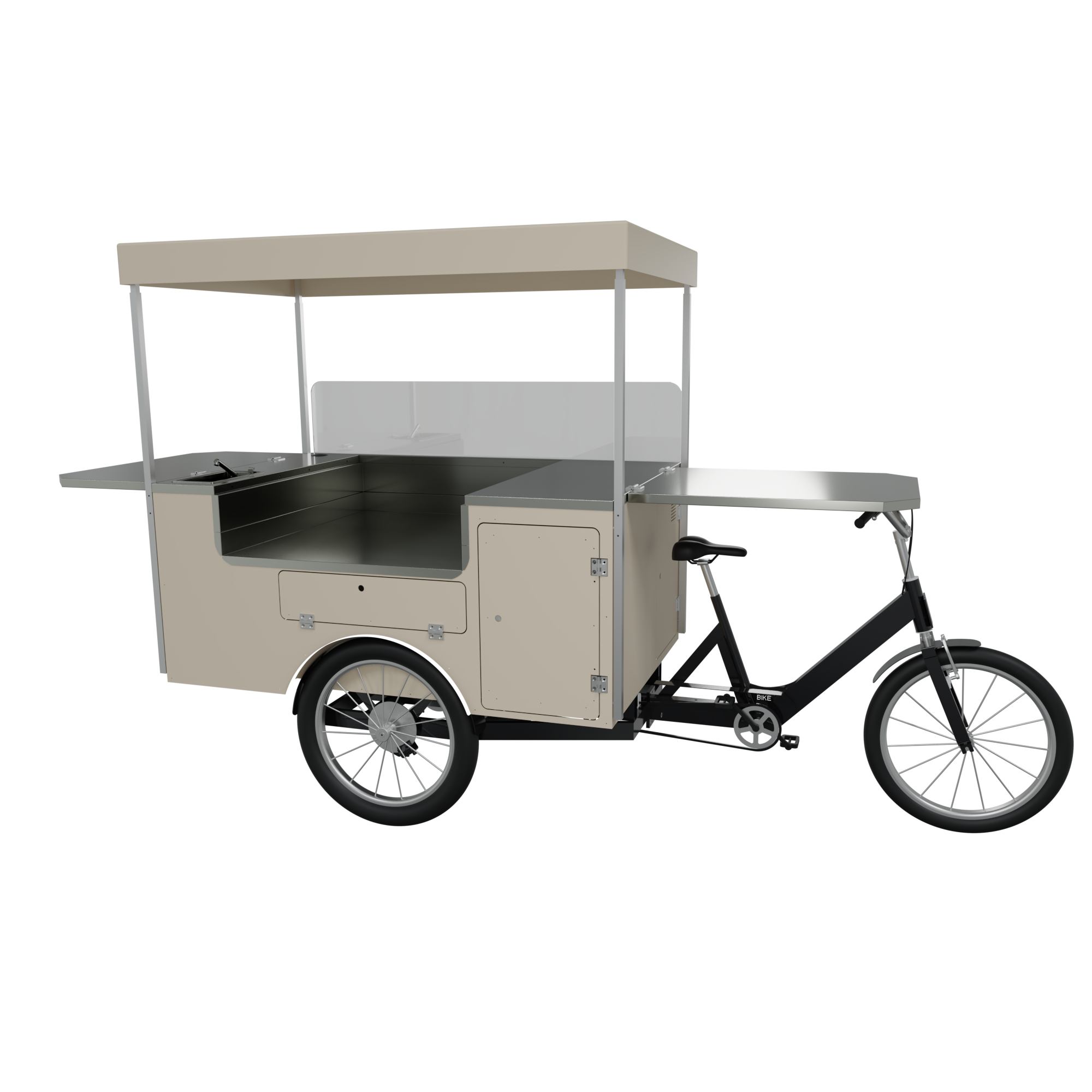

This guide is designed for anyone planning a street food cargo bike and needing a clear method to define their food concept before configuring the setup.
When you imagine doing street food with a cargo bike, the first thing that appears is your idea: the taste you want to bring, the atmosphere you want to create, the style you want to express.
To understand whether the project can really work, you must start with what you want to offer, not with the vehicle.
A cargo bike becomes effective when it is configured around a clear food concept, easy to communicate in a few words and technically sustainable.
This is the starting point of our method. The next four articles explore Space, Power Consumption, Operating Context and Mobility.
The Food Concept: the Identity of Your Street Food Project
The food concept is the core of your street food idea.
It defines your identity and helps you build a setup that works—without extra weight or unnecessary appliances.
A clear food concept can be expressed in a few words, focuses the offer on what you do best, and keeps the project efficient.
Adding too many different preparations weakens the main offer and makes the entire setup less functional.
This is the foundation of any effective street food cargo bike setup.
Configuring the Cargo Bike Around the Food Concept
We sell cargo bikes, but the real value lies in the right configuration.
It’s not about choosing a model: it’s about selecting the modules, appliances and power solutions that make your food concept possible.
This is why we developed a product configurator. It allows you to see, in real time, how different configurations affect your layout and workflow.
It ensures that your street food cargo bike is built around what truly matters.
The sequence is simple:
- define the food concept
- identify what you truly need
- configure the cargo bike accordingly
The Four Variables That Turn an Idea into a Real Project
A food concept works only if it is balanced with four key variables: Space, Power Consumption, Operating Context and Mobility.
These elements determine whether the project is sustainable in real conditions.
Space: What Really Fits on a Cargo Bike
Space is limited. Even on larger cargo bikes, you need clear priorities.
Useful questions:
- what are the two essential preparations of your food concept?
- which appliances must be onboard?
- can you keep the setup clean and efficient without losing quality?
Power Consumption: Electric, Gas and Real Autonomy
Every preparation requires energy.
Whether you use electricity, batteries or gas depends on what you serve and how long you work.
Useful questions:
- does your equipment require power peaks?
- can you work with direct electric supply?
- is there a lower-consumption alternative without reducing quality?
Operating Context: Regulations, Territory and Accessibility
The operating context is where you move and where you work.
It defines both the regulatory framework and the practical limitations.
It includes:
- the competent authority (permits, rules, allowed areas)
- the characteristics of the territory (street types, pavements, pedestrian zones, ZTL, traffic patterns, public parks and their rules)
Understanding this context prevents designing a setup that doesn’t match real conditions.
Mobility: Weight and Daily Movements
A complete setup often reaches 300–400 kg. Mobility becomes a central factor.
Useful questions:
- how much do you move each day?
- are your routes short or long?
- do you need electric assistance?
- are there slopes, uneven surfaces or cobblestones?
The Three-Step Method
Step 1 — Define your food concept
It must be concise, clear and instantly understandable.
Step 2 — Identify the technical requirements
Space, power needs, workflow, operating conditions.
Step 3 — Configure the cargo bike
Use the configurator to align the setup with what you actually need.
You can explore different layouts directly on the product pages:
Flex version: https://streetfood-bike.com/flex/
Ice Cream version: https://streetfood-bike.com/ice-cream/
Cooking version: https://streetfood-bike.com/cooking/
Beverage version: https://streetfood-bike.com/cocktail-bike/
Conclusion
A street food cargo bike works when it is configured around a solid, essential and sustainable food concept.
The bike comes after the idea: first define the identity of your offer, then select the technical choices that make it possible in real-life scenarios.
If you want support
If you are working on your food concept and want to understand which cargo bike configurations are truly sustainable in your operating context, I can help you choose the right direction from the start.are truly sustainable in your operating context, I can help you choose the right direction from the start.