
Introduction
A food bike offers many possibilities, but the most common tendency is to overload the available space. This does not improve efficiency: it increases weight, complicates operations, raises power consumption and makes the main food proposal less clear. Understanding how to organise the space in a balanced way is one of the most important steps when designing a street food workstation.
How to think about the available workspace
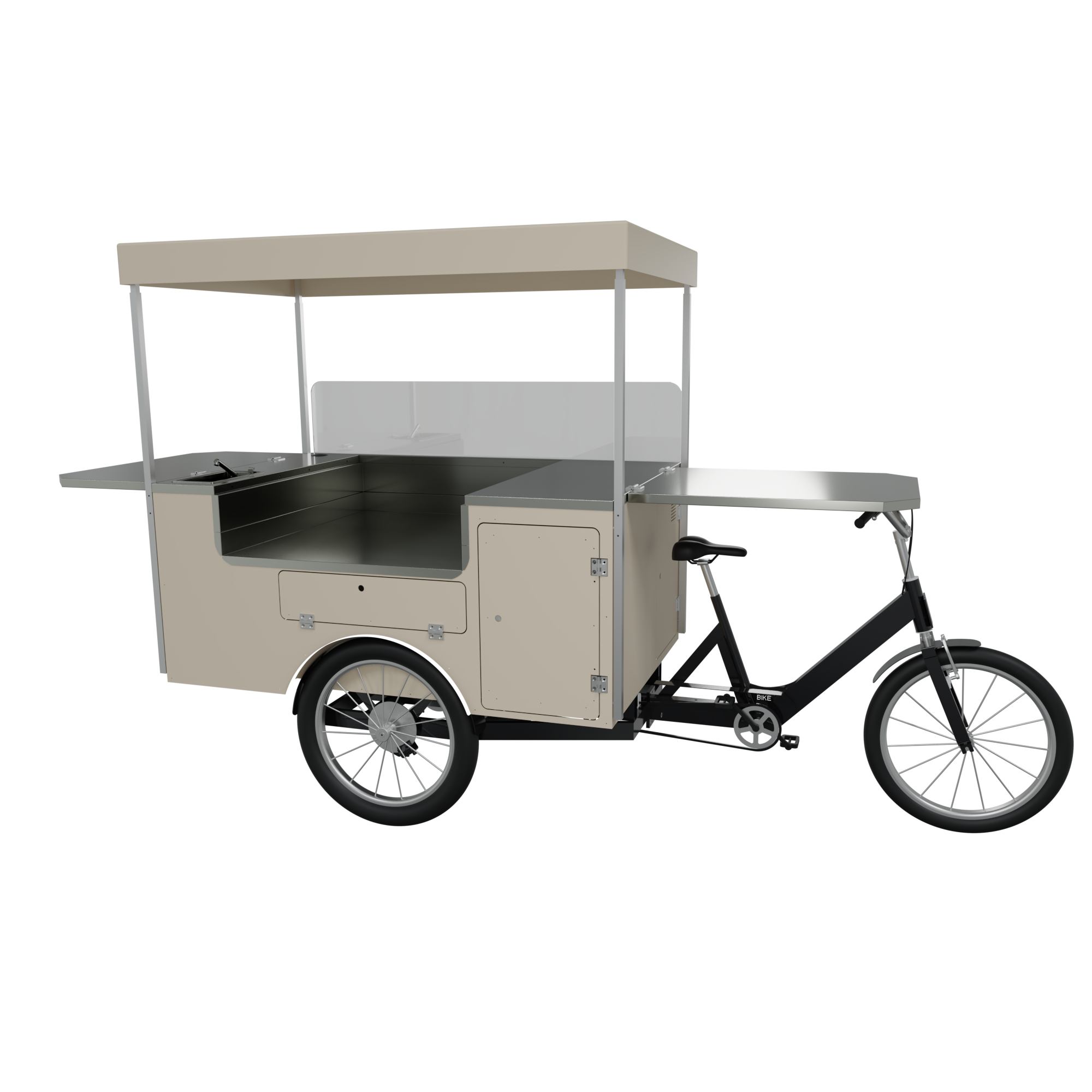
Most food bikes can host up to two cooking appliances. This is a practical limit: even the larger models usually have space for two major appliances and, in some cases, a small support refrigerator.
As examples of large appliances, we refer to fry tops, griddles, crepe makers and deep fryers.
These appliances are normally positioned in a lowered area compared to the main work surface. This compensates for their height and allows the operator to handle food safely and comfortably.
Ice cream setups are different: carapine wells often occupy the entire available area, and food bikes dedicated to gelato service typically work best when focused on this single activity. Only the most spacious cargo bikes have room for an additional refrigerator for water, soft drinks or other beverages.
Apart from appliances, the work surface must also host utensils, ready ingredients, small quick preparations and basic service operations. When the top becomes overcrowded, every step of the work slows down.
The internal compartment is equally important. Beyond the electrical or gas systems, it is used to store supplies, insulated boxes, cups, napkins, bottles, packaging and all daily consumables that must remain protected. Good internal organisation keeps the surface clear and improves workflow.
Shelves as an extension of the workspace
Many food bikes can be equipped with shelves that extend the usable surface. A front shelf makes serving customers easier; a rear shelf expands the preparation area and provides space for containers, POS devices or other useful items.
These additional surfaces improve the usability of the workstation. Since they are foldable or removable, they do not increase the size of the food bike during transport or storage. This makes them one of the most versatile features in real-life operation.
What is not recommended: adding too much
Many projects become complicated because too many appliances, too many batteries or unnecessary accessories are included “for safety”. This results in a heavier, more expensive and less efficient system.
A food bike works best when it is centred on the main food proposal. Anything additional should be evaluated with care, as every extra element affects weight, power consumption, internal space, user comfort and overall cost.
Designing the space with visual tools
Online configurators are extremely useful when planning the layout. They allow you to visualise how space changes when selecting different appliances, shelves or layout options. Seeing dimensions, colours, surfaces and canopy variations helps design a coherent setup that matches your food proposal and the way you intend to work.
Here are our dedicated configurators, which you can explore as examples:
These tools provide a quick and intuitive way to compare scenarios and make informed decisions, especially when evaluating multiple possibilities.
Conclusion
Space on a food bike should not be filled: it should be organised.
A clean, essential setup focused on what truly matters allows you to work faster, manage weight correctly, reduce energy requirements and maintain a clear and recognisable food proposal.